Friday, May 30, 2008

SN 2008D update


Astronomy Picture of the Day has a very nice optical image of NGC 2770 with SN 2008D (and last year's SN 2007uy) clearly visible. This NASA press release is the source of the labelled image shown above, which also contains a recent optical image showing the supernovae (although its not quite as pretty as the APOD one).


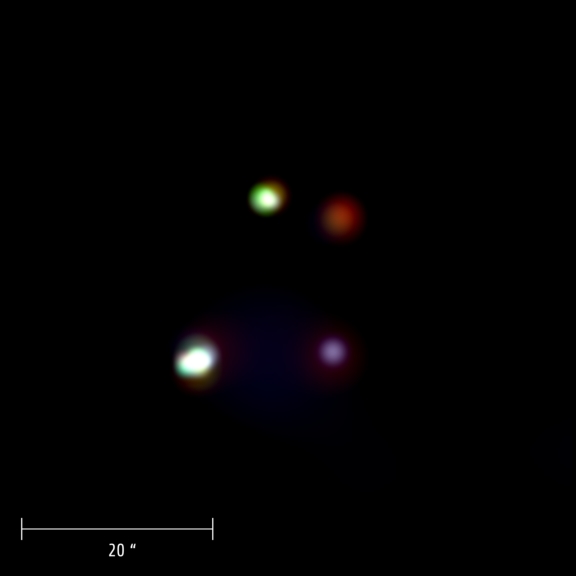
The Chandra Science Center has a press release on the Chandra observations of SN 2008D. The image on the right is the Chandra image, color-coded to show lower energy X-rays in red, intermediate energy X-rays in green, and higher energy X-rays in blue. SN 2008D is the red blob at the top right.

FYI both SN 2008D and SN 2007uy are type Ib supernova, i.e. massive star progenitors that have exhausted or expelled their hydrogen envelopes prior to exploding.

In unrelated news I am happy to see that my Cycle 17 Hubble archival proposal "Toward Understanding the Fundamental Structure of Superwinds: An Archival Study of Clouds in M82's Wind" has been approved. My thanks go out to all you anonymous reviewers!

Friday, May 23, 2008

Catching Supernova 2008D in the act

Astronomer Alicia Soderberg, a postdoctoral fellow at Princeton University and the first author of the report, was using the Burst Alert Telescope, an instrument on NASA's orbiting Swift observatory, on January 9 to study a supernova in NGC 2770 that was then two weeks in progress (but still 88 million years old, given the transit time of light). In a stroke of luck, the same galaxy suddenly flared with x-rays. "The probability of that happening is about one in 10,000," she says. "It was really exciting. We caught the whole thing on tape, basically."


They really had the luck of the Devil in catching a serendipitous supernova explosion as it happened... and in X-ray emission too. Hubble can't do that! ;) . Scientific American and Nature (*) have more information.

The image is a 3-color composite image of NGC 2770 [NASA Extragalactic Database] using 2MASS data. If you like google sky then NGC 2770 is here.

Why two supernovae so close together in time in the same galaxy? Most probably its just a statistical fluke. Prominent star-forming spiral arms are evident in the image of the galaxy, but the IRAS 60 and 100 micron flux ratio of this galaxy (~0.3) are firmly in the range of a "normal" spiral galaxy, so its not a starburst.

(*) Reading the on-line comments to the Nature article makes it clear that some people think that the World Wide Telescope (which I commented on here) is actually hooked-up, live, to real telescopes. Sadly not, but it highlights that World Wide Telescope was not a very well chosen name, perhaps even downright misleading.

Tuesday, May 20, 2008

Zap! Sterilizing planets... sounds like fun


"Flares like this would deplete the atmospheres of life-bearing planets, sterilizing their surfaces."
This alarmist language nicely describes a rather catastrophic (and hence very interesting) and unusual stellar flare on the nearby Red Dwarf star EV Lacertae, detected on April 25th by NASA's Swift satellite.

The image is from the BBC comedy series Red Dwarf, which started well but got catastrophically bad as season after season dragged on (and yet was still too high brow for an American version to take off). Just like a real Red Dwarf, it seemed to live forever...

Friday, May 16, 2008

The M81/M82 group seen through an Integrated Flux Nebula


I've mentioned Integrated Flux Nebulae before on this blog (see here), but Astronomy Picture of the Day had an awesome picture taken by Jordi Gallego showing the IFN in the region of sky hosting the M81/M82 group a few days ago. The image shown in this post is scaled-down version of Gallego's image that I've flipped to approximately have North up and East to the left, as is standard for astronomical images.

As discussed before, at optical wavelengths Integrated Flux Nebulae (the wispy grey/white filaments in the image) shine by scattering starlight off of the dust grains in the cool filamentary gas that forms the nebula. The IFN is material in our own galaxy, probably at distances of a few hundred parsecs (several hundred light years) from us, while the M81/M82 galaxy group lies much farther away in the background (about 3.6 to 3.9 million parsecs away, about 12 million light years or so).

I only just discovered google sky a few days ago, but what is really neat is that you can actually see these IFN in google sky by clicking on the Infrared tab at the top right. What you're now seeing (or click here for a direct link to the composite google sky image) in red overlaid over the optical image is Infrared Emission as seen by the IRAS satellite --- the dust grains in the IFN not only scatter star light but are heated by it, and they radiate that heat as IR emission.

Note also the bright green blob that is M82, and how much more intense the IR emission from M82 (a dust enshrouded starburst galaxy) is compared to the much larger (and somewhat more normal) spiral galaxy M81. Its a nice visual depiction of the difference in star formation modes in the two galaxies.