Showing posts with label comets. Show all posts

Saturday, July 11, 2020

Comet 2020 F3 (NEOWISE)

The long period comet C/2020 F3 (aka NEOWISE, named after the satellite that first detected it) is one of the most impressive comets in the last few decades.

Although my attempts to see it personally have so far been frustrated by cloud and lack of clear sight lines to the north-east, I have been following the images of it that have appeared in Astronomy Picture Of The Day (APOD). Most if not all of the images posted so far, or presented in pop sci articles online fail to tell you any quantitative details about what you're looking at, so I decided to work out some rough distances and sizes based on the JPL Small Body Database info on NEOWISE, and the image taken from the ISS on July 5th 2020, and the kstars desktop planetarium software.

This image is a cropped, resized and annotated version of the ISS image posted at APOD on July 10, 2020. I've labelled some of the prominent stars, although to a ground-based amateur observer the star Capella, which is hidden behind parts of the ISS off the top left of the image, would be the most most prominent star visible.

From the JPL SBDB we can find that NEOWISE was about 0.3 AU from the Sun on 7/5/2020, and about 1.1 AU (approx 165 million km) from Earth. At a distance of 1.1 AU an angular distance of 1 degree is about 3 million km.

Comet C/2020 F3 (NEOWISE) as seen from the ISS on 7/5/2020
My annotated version of APOD from 07/10/2020, Image Credit: NASA, ISS Expedition 63

The angular distance between Theta Aurigae and Elnath is approximately 10.54 degrees, and the angular distance between Elnath and Kabdhiliinan (Iota Aurigae) is approximately 7.76 degrees based on using a measuring tool in kstars. If we assume the ISS image is not significantly distorted then we can measure the number of pixels between the stars on the image and compare that to the length of the tail in the image to work out its angular size. In fact the image does seem to be be slightly distorted, but taking an average I get that the visible tail in this image is about 1.7 degrees long, so the visible tail is about 5 million km long. Its not every day you can go out and see something 5 million km in size!

Friday, November 29, 2013

Goodbye Comet ISON

Comet ISON appears to have broken up and evaporated as it approached the Sun, so we won't be seeing a spectacular show in our December skies as hoped. It seems unlikely that any remnants that do make it back out towards Earth's orbit will be much to look at.


The embedded YouTUBE video of pretty low quality, but NASA's website has high quality video versions of Comet ISON fizzling available for viewing and downloading here.

Thursday, November 28, 2013

ISON

I'm hoping that Comet ISON makes for a naked-eye spectacular in December so that the boys get to see a great comet. I still remember seeing Halley when I was a kid.

In the mean time the NASA Comet ISON Observing Campaign is the page I'm keeping an eye on. With ISON so close to the Sun it's up to serious instrumentation to keep an eye on it (don't try it yourself). Two in particular are the ones to watch:


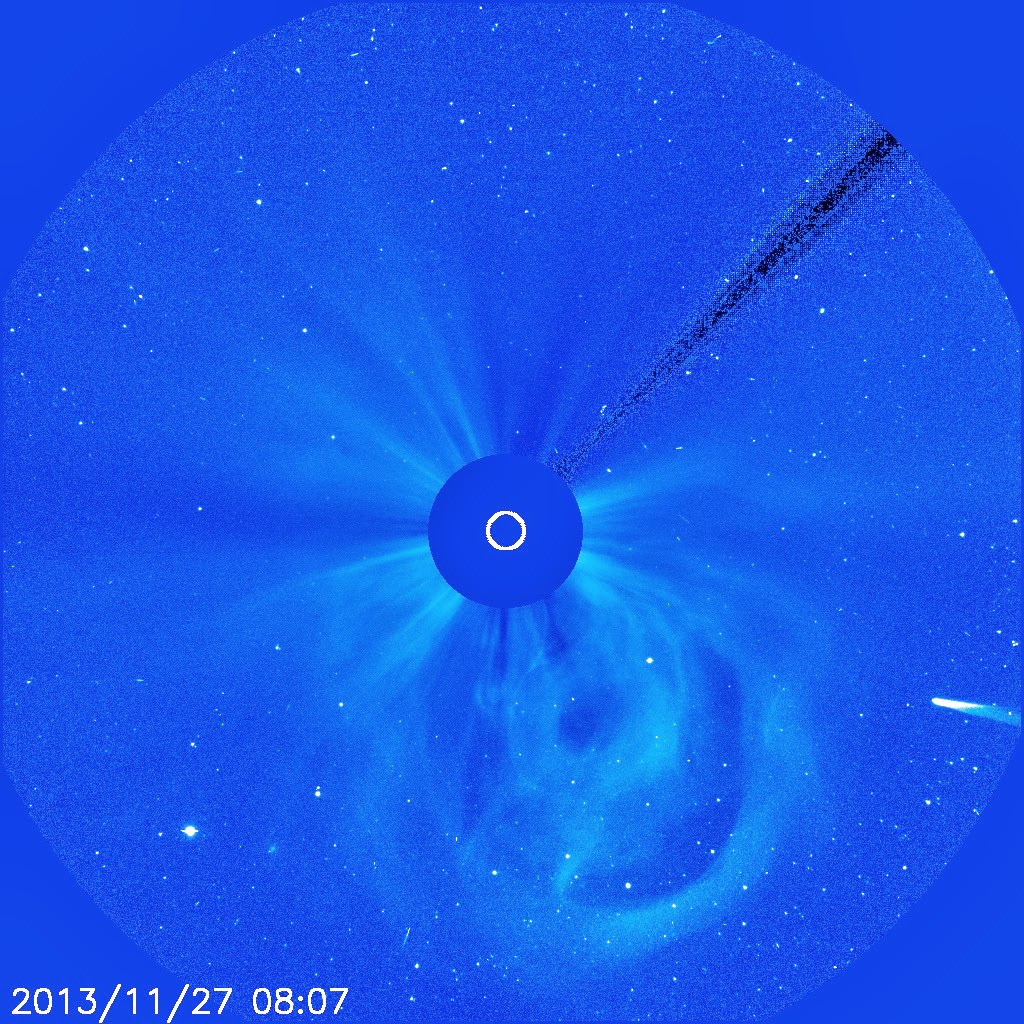
[SOHO LASCO image of the sun on November 27th, 2013, showing Comet ISON on the bottom right. Note that the Sun itself is blocked in this image so as to reveal faint coronal material, in this case a Coronal Mass Ejection towards the bottom of the image.]

Friday, November 06, 2009

Interesting Astrophysics: Nov 02 to Nov 06

Of particular note this week are Crighton et al (who suggest a particular case of intergalactic metal line absorption can be associated with a z=0.2272 galaxy polluting a region ~200 kpc in radius), Bertone et al (metal line cooling from the IGM predicted in the OWLS simulations) Risaliti & Elvis (a line driven model for AGN winds), and Bond et al (terrestrial planet formation models that correctly predict the observed elemental abundances also predict that terrestrial planets form wet and do not need significant water delivery from comets).


Galaxies and Starbursts

Searching for Evidence of Energetic Feedback in Distant Galaxies: A Galaxy Wide Outflow in a z~2 Ultraluminous Infrared Galaxy
D.M. Alexander, A.M. Swinbank, I. Smail, R. McDermid, N. Nesvadba, arXiv:0911.0014 [ps, pdf, other]
Comments: 10 pages, 5 figures, 1 table. Resubmitted to MNRAS after taking account of referees feedback

Galaxies at Redshift ~0.5 Around Three Closely Spaced Quasar Sightlines
Neil H. M. Crighton, Simon L. Morris, Jill Bechtold, Robert A. Crain, Buell T. Jannuzi, Allen Shone, Tom Theuns, arXiv:0911.0368 [pdf, other]
Comments: 45 pages, 21 figures. Accepted by MNRAS

From their abstract: "We identify a galaxy at z=0.2272 with associated metal absorption in two sightlines, each 200 kpc away. By constraining the star formation history of the galaxy, we show the gas causing this metal absorption may have been enriched and ejected by the galaxy during a burst of star formation 2 Gyr ago."

Enhanced Dense Gas Fraction in Ultra-Luminous Infrared Galaxies
S. Juneau, D. T. Narayanan, J. Moustakas, Y. L. Shirley, R. S. Bussmann, R. C. Kennicutt Jr, P. A. Vanden Bout, arXiv:0911.0413 [ps, pdf, other]
Comments: 20 pages, 10 figures. To be published in The Astrophysical Journal (accepted)


Black Holes and AGN

Comparison between the Luminosity functions of X-ray and [OIII] selected AGN
I. Georgantopoulos, A. Akylas, arXiv:0911.0102 [ps, pdf, other]
Comments: 7 pages to appear in Astronomy & Astrophysics

A non-hydrodynamical model for acceleration of line-driven winds in Active Galactic Nuclei
G. Risaliti, M. Elvis, arXiv:0911.0958 [ps, pdf, other]
Comments: 15 pages, 9 figures. Accepted for publication in Astronomy & Astrophysics


Numerical Astrophysics

Metal-line emission from the warm-hot intergalactic medium: I. Soft X-rays
Serena Bertone, Joop Schaye, Claudio Dalla Vecchia, C.M. Booth, Tom Theuns, Robert P.C. Wiersma, arXiv:0910.5723 [ps, pdf, other]

The Enrichment of Intergalactic Medium With Adiabatic Feedback I: Metal Cooling and Metal Diffusion
Sijing Shen, James Wadsley, Gregory Stinson, arXiv:0910.5956 [ps, pdf, other]
Comments: 16 pages, 11 figures, submitted to MNRAS

Ram-pressure stripping of halo gas in disc galaxies: implications for galactic star formation in different environments
Kenji Bekki, 2009, MNRAS, 399, 2221
Full Text: HTML, PDF (Size: 4409K)

The impact of feedback on the low redshift Intergalactic Medium
Luca Tornatore, Stefano Borgani, Matteo Viel, Volker Springel, arXiv:0911.0699 [ps, pdf, other]
Comments: revised version after referee's comments


Stars, Supernovae and Planets

Making the Earth: Combining Dynamics and Chemistry in the Solar System
Jade C. Bond, Dante S. Lauretta, David P. O'Brien, arXiv:0911.0426 [ps, pdf, other]
Comments: 61 pages (including online material), 12 figures (7 in paper, 5 online). Accepted to Icarus

From their abstract: "Bulk elemental abundances based on disk equilibrium studies have been determined for the simulated terrestrial planets of O'Brien et al. (2006). These abundances are in excellent agreement with observed planetary values, indicating that the models of O'Brien et al. (2006) are successfully producing planets comparable to those of the Solar System in terms of both their dynamical and chemical properties. Significant amounts of water are accreted in the present simulations, implying that the terrestrial planets form "wet" and do not need significant water delivery from other sources. Under the assumption of equilibrium controlled chemistry, the biogenic species N and C still need to be delivered to the Earth as they are not accreted in significant proportions during the formation process."

Friday, December 05, 2008

Interesting Astrophysics: Dec 01 to Dec 05

The current week's set of peer-reviewed papers and arXiv preprints I consider interesting.


Galaxies and Starbursts

Star Formation Rates in Lyman Break Galaxies: Radio Stacking of LBGs in the
COSMOS Field and the Sub-muJy Radio Source Population

C.L. Carilli, Nicholas Lee, P. Capak, E. Schinnerer, K.-S. Lee,
H. McCraken, M. S. Yun, N. Scoville, V. Smolcic, M. Giavalisco,
A. Datta, Y. Taniguchi, and C. Megan Urry, The Astrophysical Journal 2008 December 20, Vol. 689, No. 2: 883-888.
Abstract | Full Text | PDF Version (290 KB)

Evolution of Lyman Alpha Galaxies: Stellar Populations at z ~ 0.3
Steven L. Finkelstein, Seth H. Cohen, Sangeeta Malhotra, James E. Rhoads, arXiv:0812.0592 [ps, pdf, other]
Comments: Submitted to the Astrophysical Journal

Morphological Composition of z~0.4 groups: The site of S0 formation
D. J. Wilman, A. Oemler, J. S. Mulchaey, S. L. McGee, M. L. Balogh, R. G. Bower, arXiv:0811.4425 [ps, pdf, other]
Comments: 13 pages, 6 figures. Accepted for publication in ApJ

The Hubble flow around the Local Group
I.D. Karachentsev, O.G. Kashibadze, D.I. Makarov, R.B. Tully, arXiv:0811.4610 [ps, pdf, other]
Comments: 14 pages, 6 figures, 1 table. Accepted for publication in MNRAS

Binary Galaxies in the Local Supercluster and Its Neighborhood
I. D. Karachentsev, D. I. Makarov, ArXiv:0812.0689 [ps, pdf, other]
Comments: published in Astrophysical Bulletin, 2008, Vol. 63, No. 4, pp. 299-345
Journal-ref: Astrophysical Bulletin, 2008, Vol. 63, No. 4, pp. 299-345

Stellar population analysis on local infrared-selected galaxies
X. Y. Chen, Y. C. Liang, F. Hammer, Y. H. Zhao, G. H. Zhong, arXiv:0811.4694 [ps, pdf, other]
Comments: 13 pages, 11 figures, accepted for publication by A&A

EVN observations of the Ultra Luminous Infrared Galaxies IRAS 23365+3604 and IRAS 07251-0248
Cristina Romero-Cañizales, Miguel Ángel Pérez-Torres, Antxon Alberdi, arXiv:0812.0760 [pdf, other]
Comments: 3 pages, 6 figures and 1 table; needs PoS.cls. To be be published in Proceedings of Science, proceedings of The 9th European VLBI Network Symposium on The role of VLBI in the Golden Age for Radio Astronomy and EVN Users Meeting, September 23-26, 2008, Bologna, Italy

The IR Luminosity Functions of Rich Clusters
Lei Bai, George H. Rieke, Marcia J. Rieke, Daniel Christlein, Ann I. Zabludoff, arXiv:0812.0427 [ps, pdf, other]
Comments: 15 pages, 8 figures, 1 table, accepted by ApJ

The cosmic evolution of metallicity from the SDSS fossil record
Benjamin Panter, Raul Jimenez, Alan F. Heavens and Stephane Charlot, 2008, MNRAS, 391, 1117
HTML, PDF (Size: 1553K)

Intergalactic Baryons in the Local Universe
Charles W. Danforth, arXiv:0812.0602 [ps, pdf, other]
Comments: Invited review to appear in "Future Directions in Ultraviolet Spectroscopy", Oct 20-22, 2008, Annapolis, MD, M. E. Van Steenberg, ed. (April 2009). 8 pages, five figures

The Chemical and Ionization Conditions in Weak Mg ii Absorbers
Anand Narayanan, Jane C. Charlton, Toru Misawa, Rebecca E. Green, and Tae-Sun Kim The Astrophysical Journal 2008 December 20, Vol. 689, No. 2: 782-815.
Abstract | Full Text | PDF Version (3768 KB)

Galaxy merger morphologies and time-scales from simulations of equal-mass gas-rich disc mergers
Jennifer M. Lotz, Patrik Jonsson, T. J. Cox and Joel R. Primack, 2008, MNRAS, Volume 391 Issue 3, 1137
HTML, PDF (Size: 19397K)

A semi-empirical model of the infrared emission from galaxies
D. C. Ford, B. Nikolic and P. Alexander, 2008, MNRAS, Volume 391 Issue 3, 1176
HTML, PDF (Size: 644K)


Cosmology

Primordial Nucleosynthesis: an updated comparison of observational light nuclei abundances with theoretical predictions
G. Miele, O. Pisanti, arXiv:0811.4479 [ps, pdf, other]
Comments: 5 pages, 4 figures, to appear in the proceedings of NOW 2008

Synchrotron Radiation from the Galactic Center in Decaying Dark Matter Scenario
Koji Ishiwata, Shigeki Matsumoto, Takeo Moroi, arXiv:0811.4492 [ps, pdf, other]
Comments: 20 pages, 6 figures

A semi-analytic model for the co-evolution of galaxies, black holes and active galactic nuclei
Rachel S. Somerville, Philip F. Hopkins, Thomas J. Cox, Brant E. Robertson and Lars Hernquist, MNRAS, 2008, Volume 391 Issue 2, Pages 481 - 506
HTML, PDF (Size: 2550K)


The Role of Cold Flows in the Assembly of Galaxy Disks
A.M. Brooks, F. Governato, T. Quinn, C.B. Brook, J. Wadsley, arXiv:0812.0007 [ps, pdf, other]
Comments: accepted to ApJ


Numerical Astrophysics

Smart detectors for Monte Carlo radiative transfer
Maarten Baes, MNRAS, 2008, Volume 391 Issue 2, Pages 617 - 623
HTML, PDF (Size: 4538K)

Modeling the Local Warm/Hot Bubble
Dieter Breitschwerdt, Miguel A. de Avillez, Verena Baumgartner, arXiv:0812.0505 [ps, pdf, other]
Comments: 8 pages, 3 figures, to appear in the proceedings of "The Local Bubble and Beyond II", Philadelphia, USA, April 21-24, 2008


X-rays and Gamma rays

Calibration of the Gamma-RAy Polarimeter Experiment (GRAPE) at a Polarized Hard X-Ray Beam
P. F. Bloser, J. S. Legere, M. L. McConnell, J. R. Macri, C. M. Bancroft, T. P. Connor, J. M. Ryan, arXiv:0812.0782 [pdf]
Comments: 35 pages, 14 figures, accepted for publication in NIM-A

Section on Extragalactic Science Topics of the White Paper on the Status and Future of Ground-Based TeV Gamma-Ray Astronomy
H. Krawczynski et al, arXiv:0812.0793 [ps, pdf, other]
Comments: Comments: report from the Extragalactic Science Working group of the APS commissioned White paper on ground-based TeV gamma ray astronomy (12 pages, 3 figures)


Black Holes, Compact Objects, AGN

X-Ray Emission from Active Galactic Nuclei with Intermediate-Mass Black Holes
G. C. Dewangan, S. Mathur, R. E. Griffiths, and A. R. Rao, The Astrophysical Journal 2008 December 20, Vol. 689, No. 2: 762-774.
Abstract | Full Text | PDF Version (1175 KB)

Chandra Observations of Nuclear X-ray Emission from Low Surface Brightness Galaxies
M. Das, C. S. Reynolds, S. N. Vogel, S. S. McGaugh, N. G. Kantharia, arXiv:0812.0457 [ps, pdf, other]
Comments: 17 pages, 1 table, 4 figures. To appear in ApJ

Frying Doughnuts: What can the reprocessing of X-rays to IR tell us about the AGN environment?
B. McKernan, K.E.S. Ford, N. Chang, C.S. Reynolds, arXiv:0812.0984 [ps, pdf, other]
Comments: 12 pages, MNRAS accepted


Stars and Supernovae

The Scale-Free Character of the Cluster Mass Function and the Universality of the Stellar Initial Mass Function
Fernando J. Selman and Jorge Melnick, The Astrophysical Journal 2008 December 20, Vol. 689, No. 2: 816-824.
Abstract | Full Text | PDF Version (949 KB)

Semi-analytical formulas for the Hertzsprung-Russell Diagram
Lorenzo Zaninetti, arXiv:0811.4524 [pdf, other]
Comments: Pages 35, Figures 13
Journal-ref: Published on Serbian Astronomical Journal, 177, (2008), pages 73-85

Difficulties in Probing Nuclear Physics: A Study of $^{44}$Ti and $^{56}$Ni
Aimee Hungerford, Christopher L. Fryer, Francis X. Timmes, Patrick Young, Michael Bennett, Steven Diehl, Falk Herwig, Raphael Hirschi, Marco Pignatari, Georgios Magkotsios, Gabriel Rockefeller, arXiv:0811.4645 [ps, pdf, other]
Comments: To appear in the Conference Proceedings for the "10th Symposium on Nuclei in the Cosmos (NIC X)", July 27 - August 1 2008, Mackinack Island, Michigan, USA

Nucleosynthesis Calculations from Core-Collapse Supernovae
Christopher L. Fryer, Patrick Young, Michael Bennett, Steven Diehl, Falk Herwig, Raphael Hirschi, Aimee Hungerford, Marco Pignatari, Georgios Magkotsios, Gabriel Rockefeller, Francis X. Timmes, arXiv:0811.4648 [ps, pdf, other]
Comments: To appear in the Conference Proceedings for the "10th Symposium on Nuclei in the Cosmos (NIC X)", July 27 - August 1 2008, Mackinack Island, Michigan, USA

Overview of the Orion Complex
John Bally, arXiv:0812.0046 [pdf, other]
Comments: 24 pages, 15 figures. To be published in Handbook of Star Forming Regions Vol. I Astronomical Society of the Pacific, 2008, Bo Reipurth, ed

This article is particularly interesting with respect to our local vicinity in the Galaxy.


Planets and Astrobiology

The structure of the inner Oort cloud from the simulation of its formation for 2 Gyr
G. Leto, M. Jakubík, T. Paulech, L. Neslušan and P. A. Dybczyński, 2008, MNRAS, Volume 391 Issue 3, Pages 1350 - 1358
HTML, PDF (Size: 915K)

Thursday, November 06, 2008

Interesting Astrophysical Papers: Oct 20 to Nov 06.

Now that the election is out of the way, lets get back to astrophysics. Here is another set of recent papers and preprints that I consider interesting, arranged into rough categories.


Galaxies

The nucleus of NGC 253 and its massive stellar clusters at parsec scales
Juan Antonio Fernández-Ontiveros, M. Almudena Prieto, Jose Antonio Acosta-Pulido (Instituto de Astrofísica de Canarias), arXiv:0810.3250v1 [astro-ph]
Comments: 5 pages, 3 figures. Accepted for publication in MNRAS (Letters)

The Sub-parsec Scale Radio Properties of Southern Starburst Galaxies. II. Supernova Remnants, the Supernova Rate, and the Ionised Medium in the NGC 4945 Starburst
E. Lenc, S. J. Tingay, arXiv:0811.0057v1 [astro-ph]
Comments: Accepted by the Astronomical Journal. 38 pages, 7 figures,

The Sizes of Early-type Galaxies
Joachim Janz, Thorsten Lisker (ARI/Zentrum fuer Astronomie, University of Heidelberg), arXiv:0810.2999v1 [astro-ph]
Comments: Accepted by ApJL; 5 page, 3 figures

Low-Level Nuclear Activity in Nearby Spiral Galaxies
Himel Ghosh and Smita Mathur, The Astrophysical Journal, 687:216–229, 2008 November 1

Dust and Gas as Seeds for Metal-Poor Star Formation
Deidre A. Hunter (Lowell Observatory), arXiv:0810.5069v1 [astro-ph]
Comments: To be published in "Low Metallicity Star Formation: From the First Stars to Dwarf Galaxies," Proceedings of IAU Symposium No. 255, eds. L.K. Hunt, S. Madden, & R. Schneider (Cambridge: Cambridge Univ Press)

Spitzer/IRS Mapping of Local Luminous Infrared Galaxies
Miguel Pereira-Santaella, Almudena Alonso-Herrero, George H. Rieke, Luis Colina, arXiv:0810.5088v1 [astro-ph]
Comments: 4 pages, 5 figures. To appear in "Highlights of Spanish Astrophysics V", Proceedings of the VIII Scientific Meeting of the Spanish Astronomical Society (SEA) held in Santander, 7-11 July, 2008

Resolution of the Distance Ambiguity for Galactic HII Regions
L. D. Anderson, T. M. Bania, arXiv:0810.5570v1 [astro-ph]
Comments: Accepted to ApJ

Massive star formation in Wolf-Rayet galaxies: I. Optical and NIR photometric results
Angel R. Lopez-Sanchez, Cesar Esteban, arXiv:0811.0202v1 [astro-ph]
Comments: Published in A&A, 491, 131 (2008). 39 Figures have NOT been included
here. Full version in this http URL False color pictures of the galaxies can be found in this http URL

Chandra Acis Survey of X-Ray Point Sources in 383 Nearby Galaxies I. the Source Catalog
Jifeng Liu, arXiv:0811.0804v1 [astro-ph]
Comments: 77 pages, 14 figures, 5 tables


Numerical Astrophysics and Hydrodynamics

Modeling the Disk (three-phase) Interstellar Medium
Gerhard Hensler, arXiv:0810.3347v1 [astro-ph]
Comments: 14 pages, to be published in Proceed. IAU Symp. No. 254, "The Galaxy Disk in Cosmological Context", J. Andersen, J. Bland-Hawthorn, & B. Nordstroem (eds.), 2009, invited review

Supernova Explosions and the Triggering of Galactic Fountains and Outflows
E. M. de Gouveia Dal Pino, C. Melioli, A. D'Ercole, F. Brighenti, A. Raga, arXiv:0811.0038v1 [astro-ph]
Comments: 9 pages, 7 figures, invited paper accepted to: "Magnetic Fields in the Universe II: from Laboratory and Stars to the Primordial Structures", RevMexAA


Visualization and Computing

Algorithmic comparisons of decaying, isothermal, compressible turbulence. I. Low-resolution simulations with fixed grids
S. Kitsionas, R. Klessen, C. Federrath, W. Schmidt, D. Price, J. Dursi, M. Gritschneder, S. Walch, R. Piontek, J. Kim, A.-K. Jappsen, P. Ciecielag, M.-M. Mac Low, arXiv:0810.4599v1 [astro-ph]
Comments: Submitted to A&A, 26 pages, 120 figures

Interchanging Interactive 3-d Graphics for Cosmology
C. J. Fluke, D. G. Barnes, N. T. Jones, arXiv:0810.4201v1 [astro-ph]
Comments: 10 pages, 7 figures, submitted to Publications of the Astronomical Society of Australia, Supporting demonstrations are available at this http URL


Stars and Stellar Evolution

The evolution of massive and very massive stars in clusters
Dany Vanbeveren, arXiv:0810.4781v1 [astro-ph]
Comments: 16 pages, 7 figures, Review talk presented at the conference From Taurus to the Antennae, Sheffield 4-8th August 2008

The mass-radius relationship from solar-type stars to terrestrial planets: a review
G. Chabrier, I. Baraffe, J. Leconte, J. Gallardo, T. barman, arXiv:0810.5085v1 [astro-ph]
Comments: Cool Stars, Stellar Systems and the Sun 15, invited review

Tycho Brahe's 1572 supernova as a standard type Ia explosion revealed from its light echo spectrum
Oliver Krause, Masaomi Tanaka, Tomonori Usuda, Takashi Hattori, Miwa Goto, Stephan Birkmann, Ken'ichi Nomoto, arXiv:0810.5106v1 [astro-ph]
Comments: 15 pages, 3 figures - accepted for publication in Nature


Cosmology

The Impact of Feedback on Disk Galaxy Scaling Relations
Aaron A. Dutton, Frank C. van den Bosch, arXiv:0810.4963v1 [astro-ph]
Comments: 25 pages, 14 figures, submitted to MNRAS

GalICS II: the [alpha/Fe]-mass relation in elliptical galaxies
A.Pipino, J.E.G. Devriendt, D.Thomas, J.Silk, S.Kaviraj, arXiv:0810.5753v1 [astro-ph]
Comments: 12 pages, 13 figure, A&A submitted, comments welcome


Planets, Comets and assorted small fry

Extrasolar Giant Planets and X-Ray Activity
Vinay L. Kashyap, Jeremy J. Drake, and Steven H. Saar, The Astrophysical Journal, 687:1339–1354, 2008 November 10.

A New Orbit Determination for Bright Sungrazing Comet of 1843
Zdenek Sekanina and Paul W. Chodas, The Astrophysical Journal, 687:1415–1422, 2008 November 10

Planet formation in the habitable zone of alpha Centauri B
Philippe Thebault, Francesco Marzari, Hans Scholl,
arXiv:0811.0673v1 [astro-ph]
Comments: accepted for publication in MNRAS


Bragging rights

The Science Impact of Astronomy PhD Granting Departments in the United States
Anne L. Kinney, arXiv:0811.0311v1 [astro-ph]
Comments: 18 pages, 6 figures

Monday, June 30, 2008

100 years since the Tunguska Explosion


The Tunguska Explosion took place on June 30th 1908, exactly 100 years ago today. Although it is almost certain that it was the result of an small asteroid or comet exploding in the atmosphere with an estimated yield(*) equivalent to 20 million tons of TNT (i.e. over a thousand times more energy than released by the atomic bomb dropped on Hiroshima), many mysteries still remain.

Scientific American had an interesting article on Tunguska in its June 2008 edition, on the search for a crater. Space.com has another article worth a look, which has some fun at the end by mentioning some of the more outlandish hypotheses put forward over the years: an alien space ship blowing up, a mini-black hole passing through the Earth, or Tesla's experimental death ray.

(*) The explosion of 1 ton of TNT is equivalent to the release of 4.18e9 Joules of energy (see here), so roughly the Tunguska explosion was about 8.4e15 Joules, or 8.4e22 ergs. By way of comparison the luminosity of the Sun is 3.845e33 ergs per second.

[The image is of trees flattened by the explosion, taken twenty years afterwards by the Kulik expedition. Source: APOD for 2007 November 14]

Thursday, November 08, 2007

Comets, X-rays, and Pumpkins


I've been rather busy lately writing a NSF grant proposal, so I haven't written any posts for a while. Despite the time-crunch, I feel like taking a few minutes to briefly mention Comet Holmes which I managed to see with the naked eye (even from light-polluted Baltimore suburbia) last week and the week before.

As everyone is probably now aware, Comet 17P/Holmes is currently visible to the naked eye (to find it check out this S&T article, or the easier-to-use directions from SPACE.com), after undergoing a dramatic and unexpected increase in luminosity believed to be associated with some form of explosive out-gassing. Note is only through binoculars or a telescope that the truly diffuse nature of the comet is apparent, but even with small binoculars it was pretty impressive. Far more impressive to my mind than Halley was in 1986, so if you haven't seen it yet please go look for it.

Indeed, this one of rare astronomical phenomena that is more impressive to see yourself than when viewed as a picture taken with a big telescope (Astronomy Picture of the Day has a whole series of Comet Holmes images: 1, 2, 3, 4, 5).

I have a soft spot for comets, I worked very briefly (for a few hours) on trying to explain the X-ray emission from comets. The material evaporating off a comet is very cold (only about T~50 K), so it was a great surprise when X-ray emission was discovered coming from Comet Hyakatuke in 1996 using the ROSAT X-ray telescope (see e.g. Glanz, 1996, Science, 272, 194). Many explanations were advanced at the time, the vast majority of which did not work out. As the Solar wind has a velocity of several hundred km/s, one hypothesis was that a shock wave caused by the interaction of the Solar wind with the cometary halo caused X-ray emission by thermal bremsstrahlung. Ian Stevens, my thesis advisor at the time, performed hydrodynamical simulations of this, and my job was to take the simulations and calculate the expected X-ray luminosity. Which turned out to be orders of magnitude less than the observed emission, hence disproving the hypothesis. We didn't even bother considering to publish the results.

The real explanation for the cometary X-ray emission turned out to be charge exchange with the Solar wind. The material in the Solar wind is highly ionized, while the material out-gassed from the comet is largely neutral. A highly ionized ion interacts with a neutral atom, basically stealing one or more electron from the neutral atom. The formerly neutral atom is now ionized, and is left in an excited state. This excited state decays to a ground state by the emission of one or more photons. Dennis Bodewits PhD thesis "Cometary X-rays : solar wind charge exchange in cometary atmospheres" (2007, The University of Groningen) deals with many aspects of X-ray emission from comets, and is available chapter by chapter in PDF form.

Ironically solar wind charge exchange (SWCX) has now been recognized as a process than almost all X-ray astronomers must worry about (see Snowden et al 2004, ApJ, 610, 1182), even those like me who study distant galaxies. SWCX is now recognized as a major contributor to the soft X-ray background that affects all X-ray observations, and which makes observing faint diffuse X-ray emission difficult. Worse still, the SWCX can be time variable, further complicating background estimation and removal.


In acknowledgement of this link my Halloween pumpkin this year was a comet, which looked quite good until our local deer ate it.