Monday, November 12, 2007

The Biggest Eyes in the Sky

NASA's "Great Observatories": Hubble, Chandra, Spitzer and Compton, cost on average $1-2 billion each to build, launch and operate, in a program that has well taken over twenty years to develop. By way of comparison, NASA spends approximately $1.3 billion per year on astrophysics (excluding Solar and Solar system related research), or about $5 billion per year on science in total, out of a total budget of $18 billion per year. This useful PDF describes the Great Observatories program, its aims, and NASA's budget.

Together they covered much of electromagnetic spectrum inaccessible to ground based observatories due to atmospheric absorption: Hubble probed ultraviolet as well as optical wavelengths, Spitzer probed lower energy infra-red radiation, while Chandra and Compton were sensitive to X-ray and Gamma ray radiation respectively. In many ways they are the most advanced telescopes ever created by mankind, for those specific wavelengths.

However, for the optical, near-IR and radio wavebands there is no doubt that much better telescopes have been launched into space, and built at greater cost to the public. The difference is that they're not pointed outward but instead inwards, down at the Earth. They are, of course, spy satellites. Quite apart from the vital intelligence-gathering work they do, they're fascinating and impressive technical accomplishments.

The NYT has a fascinating article by Philip Taubman about spy satellites, more specifically about the financial woes affecting latest generation of US spy satellites. Well worth a read when you're having a break from work.

[Edited at Mon Nov 12 11:09 to fix formatting and note article is mainly about the financial aspects of the spy satellite program]

Thursday, November 08, 2007

Comets, X-rays, and Pumpkins


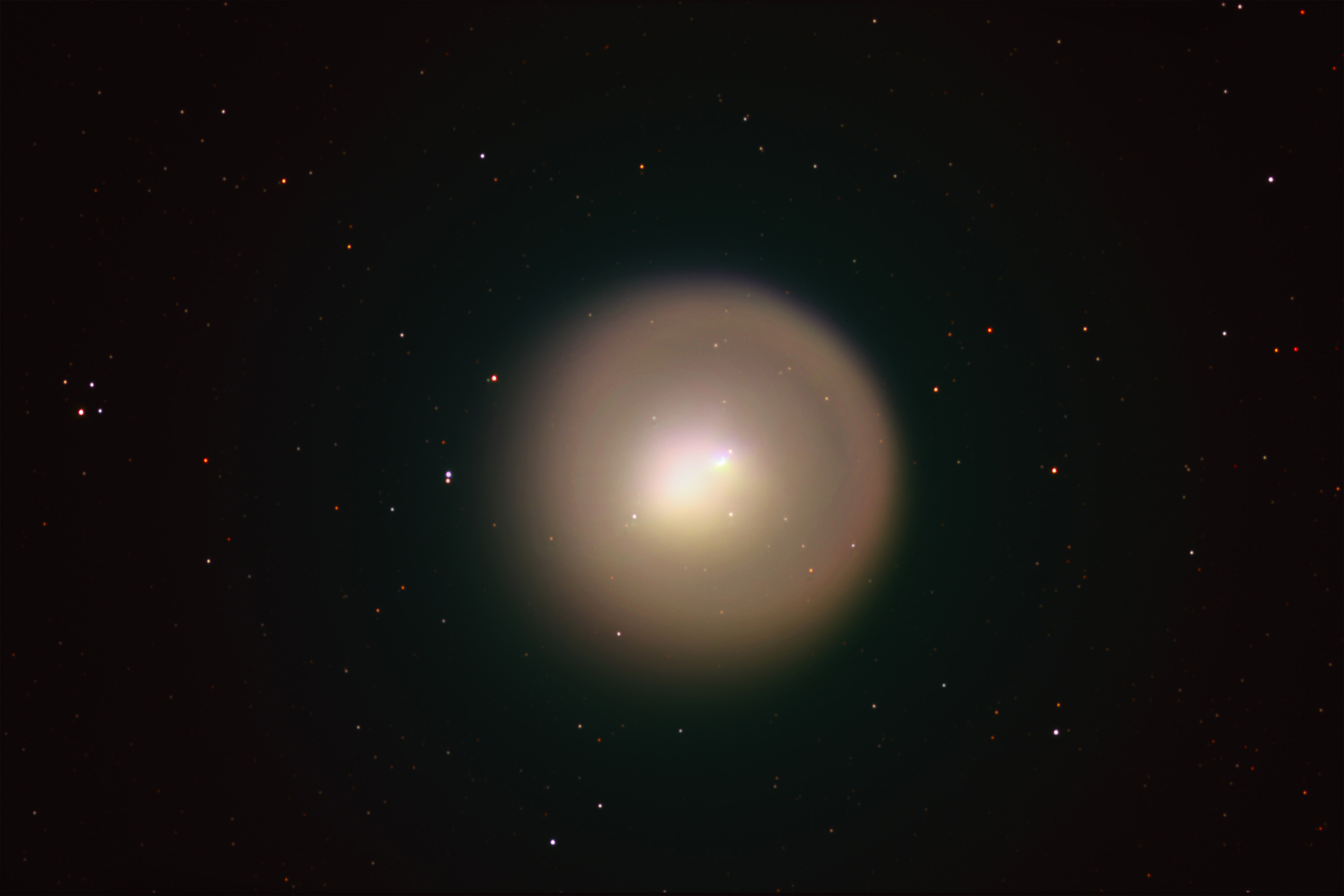
I've been rather busy lately writing a NSF grant proposal, so I haven't written any posts for a while. Despite the time-crunch, I feel like taking a few minutes to briefly mention Comet Holmes which I managed to see with the naked eye (even from light-polluted Baltimore suburbia) last week and the week before.

As everyone is probably now aware, Comet 17P/Holmes is currently visible to the naked eye (to find it check out this S&T article, or the easier-to-use directions from SPACE.com), after undergoing a dramatic and unexpected increase in luminosity believed to be associated with some form of explosive out-gassing. Note is only through binoculars or a telescope that the truly diffuse nature of the comet is apparent, but even with small binoculars it was pretty impressive. Far more impressive to my mind than Halley was in 1986, so if you haven't seen it yet please go look for it.

Indeed, this one of rare astronomical phenomena that is more impressive to see yourself than when viewed as a picture taken with a big telescope (Astronomy Picture of the Day has a whole series of Comet Holmes images: 1, 2, 3, 4, 5).

I have a soft spot for comets, I worked very briefly (for a few hours) on trying to explain the X-ray emission from comets. The material evaporating off a comet is very cold (only about T~50 K), so it was a great surprise when X-ray emission was discovered coming from Comet Hyakatuke in 1996 using the ROSAT X-ray telescope (see e.g. Glanz, 1996, Science, 272, 194). Many explanations were advanced at the time, the vast majority of which did not work out. As the Solar wind has a velocity of several hundred km/s, one hypothesis was that a shock wave caused by the interaction of the Solar wind with the cometary halo caused X-ray emission by thermal bremsstrahlung. Ian Stevens, my thesis advisor at the time, performed hydrodynamical simulations of this, and my job was to take the simulations and calculate the expected X-ray luminosity. Which turned out to be orders of magnitude less than the observed emission, hence disproving the hypothesis. We didn't even bother considering to publish the results.

The real explanation for the cometary X-ray emission turned out to be charge exchange with the Solar wind. The material in the Solar wind is highly ionized, while the material out-gassed from the comet is largely neutral. A highly ionized ion interacts with a neutral atom, basically stealing one or more electron from the neutral atom. The formerly neutral atom is now ionized, and is left in an excited state. This excited state decays to a ground state by the emission of one or more photons. Dennis Bodewits PhD thesis "Cometary X-rays : solar wind charge exchange in cometary atmospheres" (2007, The University of Groningen) deals with many aspects of X-ray emission from comets, and is available chapter by chapter in PDF form.

Ironically solar wind charge exchange (SWCX) has now been recognized as a process than almost all X-ray astronomers must worry about (see Snowden et al 2004, ApJ, 610, 1182), even those like me who study distant galaxies. SWCX is now recognized as a major contributor to the soft X-ray background that affects all X-ray observations, and which makes observing faint diffuse X-ray emission difficult. Worse still, the SWCX can be time variable, further complicating background estimation and removal.


In acknowledgement of this link my Halloween pumpkin this year was a comet, which looked quite good until our local deer ate it.

Friday, October 19, 2007

Component analysis, causal inference, and general intelligence

The aim of astronomy is astrophysics - we observe to Universe with the hope of using the resulting data to understand the fundamental physical processes that give rise to its observed properties.

As with many sciences the data obtained from observation (experimentation, in other sciences) itself does not uniquely tell you the physics or what caused what. Instead one normally investigates to look for correlations between different aspects of the data.

For example it is known that the surface brightness, effective radius and velocity dispersion of the stars in elliptical galaxies are strongly correlated, a result now called the fundamental plane. Another example is that in starburst galaxies the soft X-ray luminosity is linearly proportional to the galaxies far-IR luminosity because, causually, the FIR traces the formation rate of massive stars, the same stars that very rapidly die and whose supernovae heat the ISM to X-ray-emitting temperatures.

Various methods of investigating correlations between multiple variables exist (e.g. principal component analysis), now often referred to as "data mining." The problem is that these methods, while useful at recasting the data in ways that aid visualization of any correlations in the data variables, do not necessarily tell you what caused what.

An interesting discussion of these often-forgotten issues and complexities, one is applicable even to astrophysics, can be found in Cosma Shalizi's article on the myth of g, the so-called general factor of intelligence. Indeed, he argues that while factor analysis is perfectly valid for data exploration or model testing, as a method for finding causal structure it is not reliable (it can be right, but often its completely wrong and can fool you).

All very interesting, and rather important to understand in the wake of a certain elderly Nobel-prize winner's recent counter-factual comments.

Wednesday, October 17, 2007

Rumors of the LTSA program returning

Steinn Sigurdsson reports rumors that the NASA LTSA (Long Term Space Astrophysics) funding program may return. The LTSA program has been not offered for several years due to budget cuts.

This would be good news for younger researchers in the space sciences, in particular those using mainly HST, Chandra, XMM-Newton or Spitzer data, who are ineligible for the currently remaining funding programs like the ADP. Let us hope the rumor is true.